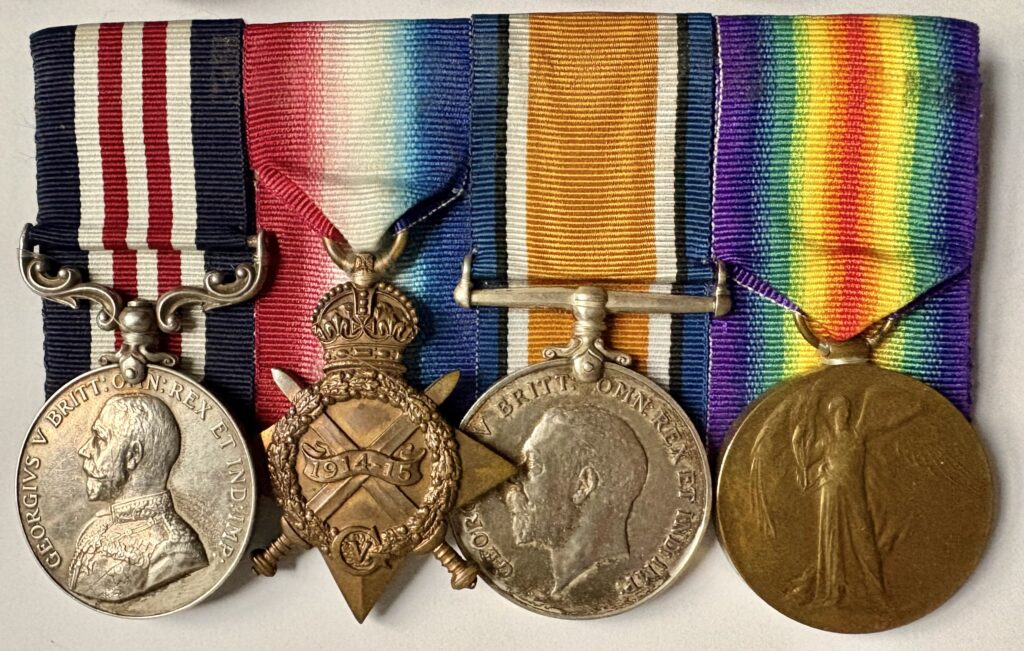
First World War Medals

British War and Victory Medals, Territorial Force War Medal, Belgium Croix De Guerre, Corporal East Riding of Yorkshire Royal Garrison Artillery Territorial Army who served in France with Numbers 29 and 77 Siege Batteries and was awarded the Belgian Croix De Guerre in April 1918.


British War and Victory Medals


382345 Cpl R Bateman RA


Territorial Force War Medal


675 GNR R Bateman RA


Belgium Croix De Guerre


Unnamed as awarded


Mounted as originally worn.


With copy service papers, copy Medal Index Card which records change of service number, copy London Gazette entry.


Royce Bateman was born in Hook, East Riding of Yorkshire 16th November 1891, a 22 year 9 month old Labourer residing at 20 Alma Street, Drypool he attested for the East Riding of Yorkshire Royal Garrison Artillery Territorial Army 2nd August 1914 and served in France from 4th August 1916 with 29 Siege Battery Royal Garrison Artillery. Awarded the Belgium Croix De Guerre London Gazette 15th April 1918 page 4527 ‘For distinguished services rendered during the course of the campaign’, , home town recorded as Drypool. Discharged 24th February 1919 unfit for military service age 27 (awarded Silver War Badge number 382090) he had been evacuated to England on 21st May 1918 via Ambulance Train Number 20, at the time was serving with 77 Siege Battery Royal Garrison Artillery. Royce attested for the second time into his old unit on 27th March 1923 as Gunner, appointed Lance Bombardier 16th August 1923, promoted Bombardier 19th July 1924, he was discharged 7th April 1927. The 1921 census records Royce is a 29 year 7 month old Dock Labourer employed by the Ellerman and Wilson Line Limited, Alexandra Dock, Hull residing with his wife Clara and son at 20 Alma Street, Church Street, Hull. The 1939 Register records Royce is a Telegraph Pole Inspector residing with his wife and son at Main Street (West), Howden, Yorkshire he died in Hull on 26th April 1974


NEF £375 SOLD

British War Medal, Victory Medal and Territorial Force War Medal, Private, Shropshire Yeomanry later 10th (Shropshire Yeomanry) Battalion Shropshire Light Infantry.


British War and Victory Medals


1767 Pte J Price Shrops Yeo


Territorial Force War Medal


1767 Pte J Price Shrops Yeo


With original silk ribbons.


James Price served in the Shropshire Yeomanry Number 1767 and the 10th Battalion King’s Shropshire Light Infantry Number 230184.


The 10th (Shropshire and Cheshire Yeomanry) Battalion, King’s Shropshire Light Infantry (10/KLSI) was formed from the amalgamation of the Shropshire Yeomanry and Cheshire Yeomanry on 2nd March 1917 at Halmieh Camp, near Cairo, Egypt. 10/KLSI formed part of the 231st Brigade which was part of the 74th (Yeomanry) Division. The shortage of horses for the yeomanry regiments had resulted in conversion to an infantry role. 10/KLSI was commanded by Lieutenant-Colonel Henry Heywood-Lonsdale and served mainly in XX Corps in Egypt and Palestine.


GVF & better £425 Available includes postage UK address

Military Medal GV, 1914/15 Star, British War and Victory Medals to Corporal, 6th Battalion Shropshire Light Infantry, the recipient awarded the Military Medal for the Battle of St Quentin during the German Spring Offensive 22nd to 25th March 1918. The recipient born in Swansea in 1894, he resided and worked there for most of his life and died in Swansea in 1965.


Military Medal GV


11726 Cpl H Parker 6/Shrops LI


1914/15 Star


11726 Pte H Parker Shrops LI


British War and Victory Medals


11726 Cpl H Parker Shrops LI


Court mounted for display.


With copy research and details here extracted from online records.


Born Edward Henry Parker in Swansea 14th July 1894, the 1911 census records Edward is a 16 year old Engine Cleaner employed by the London and North West Railway Company residing with his father Henry a Dock Labourer, mother Mary Jane, three brothers and three sisters at 38 Janes Street, Swansea. Edward attested for the King’s Shropshire Light Infantry shortly after the outbreak of war serving as ‘Harry Parker’. Joining the 6th Battalion, he served in France from 24th July 1915, his British War and Victory Medal roll entry records service with the 6th Battalion only TNA WO329/1472 page 965 refers. The 6th Battalion were formed in Shrewsbury in September 1914 as part of Kitchener’s New Armies, drawing volunteers from towns across Shropshire. Attached to the 60th Brigade in the 20th (Light) Division they landed  in France in July 1915 and fought entirely on the Western Front, participating in major actions including the Battle of Loos (1915), the Somme (1916, including Serre), and Ypres (1917). Awarded the Military Medal London Gazette1918 page 2839. Recorded as wounded in action in War Office Daily Casualty List number 5591 dated 13th June 1918, his wounding also recorded in the Ludlow Advertiser 29th June 1918. ‘Harry’ recovered from his wound and was discharged to Class ‘Z’ Army Reserve 17th February 1919. Edward married Mary Jane Rees (1895-1980) in Swansea in 1916 (presumably whilst on leave), the 1921 census records ‘Harry Parker’ (back to his preferred name) is a 26 year 11 month old Dry Dock Labourer residing with his mother, two brothers and one sister (wife absent) at 38 James Street, Swansea. The 1939 Register records Edward Henry Parker (back to his real name for his identification document) is employed as a Gas Washer at the Power Station residing with his wife Mary Jane and daughter at 213 Bonymaem Road, Swansea, he died in Swansea in 1965.


Military Medal was awarded for gallantry during the battle of St Quentin (German Spring Offensive), the Regimental History records the action –


At 1330 hours on 22nd March 1918 the enemy attacked and drove in the Regiments holding the line in front of the 6th Battalion. The 6th King’s Shropshire Light Infantry (KSLI) under Lt Colonel H E Welsh, on the right, made a final stand west of Happencourt, with the enemy on both flanks. As the Germans came down shouting and singing, they were surprised by Lewis Gun fire from the Battalion, and were completely routed. At 2300 hours the Germans who had crept up close, under cover of a dense mist, drove a wedge between two companies of the 12th King’s Royal Rifle Corps and got into the trenches of 6th KSLI, cutting off practically the whole of ‘B’ company and taking many prisoners. Colonel Welch led a counter attack with his own Battalion HQ, but was driven back by overwhelming numbers. The companies retiring in different directions became separated from the Brigade until the afternoon of the 24th. On the 28th the Battalion was relieved by the French, and concentrated with the Brigade east of Hangest. The Brigade was soon reformed and on the 29th marched to Rifle Wood. The same day the 6th KSLI went to the support of 59th Brigade which was heavily attacked around Mexieres. About 1430 hours Lt Colonel Welch was mortally wounded by shrapnel and died a quarter of an hour afterwards near Villers.


On the 31st the Division was again heavily attacked, and the 6th KSLI, coming up from a position south east of Domart to protect the right flank, succeeded in stopping the enemy advance for a time and causing his serious loss. The cavalry came up on this occasion and secured the right flank, the 6th KSLI and 11th DLI being placed under the command of the General Officer Commanding Cavalry until the Division was relieved on 2nd April. The incessant fighting in March, and the extremely heavy losses suffered, left the Division unfit to take the field. Large reinforcements came to 6th KSLI and no time was lost in reorganising the Battalion. On the 1st and 3rd May the Battalion was with its Brigade in the Avion and Lens sector. On the 25th the undermentioned NCO’s and men were awarded the Military Medal for bravery during the periods 22nd March to 1st April 1918………..Corporal H Parker (a total of 20 Military Medals awarded and one second award bar to the Military Medal).


GVF & better £575 Available includes postage UK address
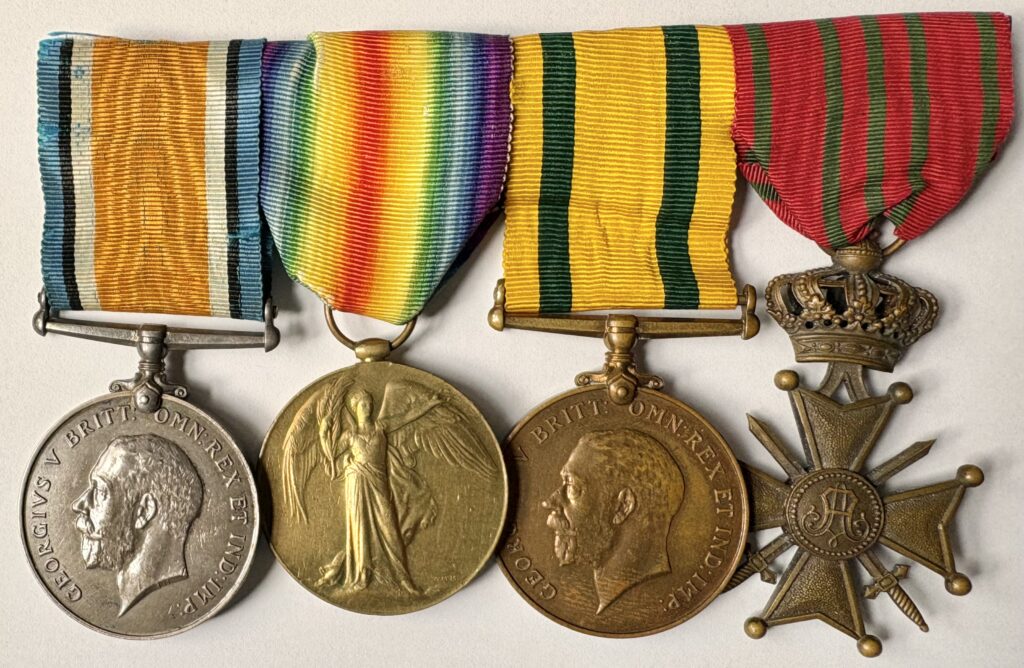
1914/15 Star, British War and Victory Medals, Sergeant 19th (Glamorgan Pioneer) Battalion Welsh Regiment.

1914/15 Star
.
31555 Pte H J Abbott Welsh R
.
British Ware and Victory Medals 
.
31555 SJT H J Abbott Welsh R
.
Henry James Abbott served in France from 5th December 1915, his British War and Victory Medal roll confirms he served with the 19th Battalion only being an original member of this Battalion, he was discharged to the Army Reserve 27th January 1919.
.
The 19th (Glamorgan Pioneers) Battalion, Welsh Regiment (Welch Regiment), was raised at Colwyn Bay in February 1915 as a specialist Pioneer unit. Assigned to the 38th (Welsh) Division, they landed in France in December 1915 and served on the Western Front throughout the Great War. Their primary duties included building and repairing trenches, constructing dugouts, laying light railways, and clearing roads, often under heavy enemy fire. During their service, they participated in several major engagements: The Somme (1916) including the operations at Mametz Wood 9th to 11th July in which the Battalion suffered severe casualties, Third Battle of Ypres (1917), attacks on the Hindenburg Line and final advance (1918). 
.
NEF £110 Available includes postage UK address

British War and Victory Medals Private, Dorset Yeomanry wounded in action in Palestine in 1917, a Farmer in Somerset and Dorset.


British War and Victory Medals


1797 Pte G Bird Dorset Yeo


(Corps of Hussars later service number 230950).


George Gordon Bird was born in Exeter, Devon 1st August 1891 and baptised in Exeter Cathedral 27th August 1891. The 1911 census records he is a 20 year old Railway Clerk a boarder residing at 2 Station Road, Yeoford Copplestone, Crediton, Devon. George attested for the Dorset Yeomanry and served overseas after January 1916, his Medal Index Card records the award of the British War and Victory Medals only. Recorded as wounded in action (in Palestine) in War Office Daily Casualty List number 5366 dated 17th September 1917, his home town recorded as Melbourne Port (Somerset). Discharged from the Dorset Yeomanry 30th September 1919 he was awarded a pension of 17 shillings and 3 pence per week in respect of a (gunshot) wound left knee and the effects of contracting Dysentery – to commence 30th September 1919, home address recorded as Bugle Farm, Melbourne Port, Somerset. The 1921 census records George is a Farmer (and employer) residing with his wife Phillis and daughter at Woodrow, Hazelbury Bryan, Sturminster, Dorset, he died in Chalbury, Dorset in 1961.


NEF £150 Available includes postage UK address.