Gallantry and Distinguished Service

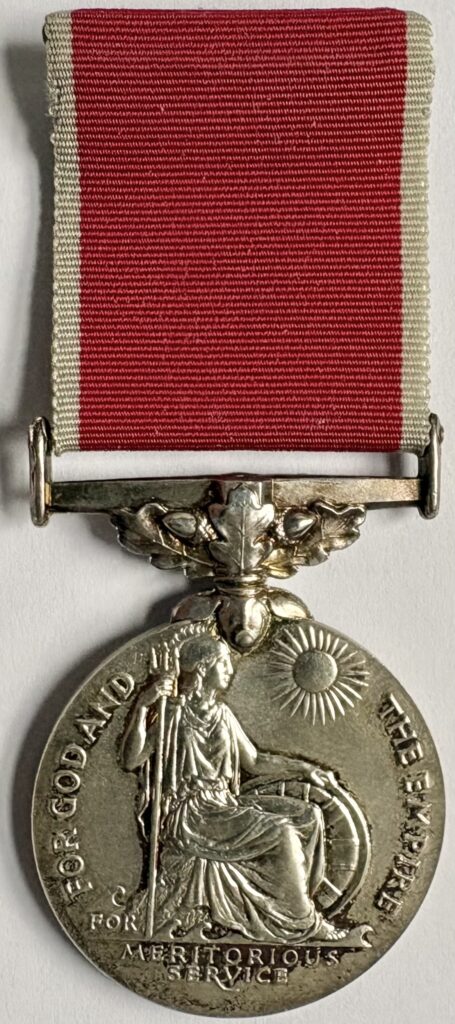
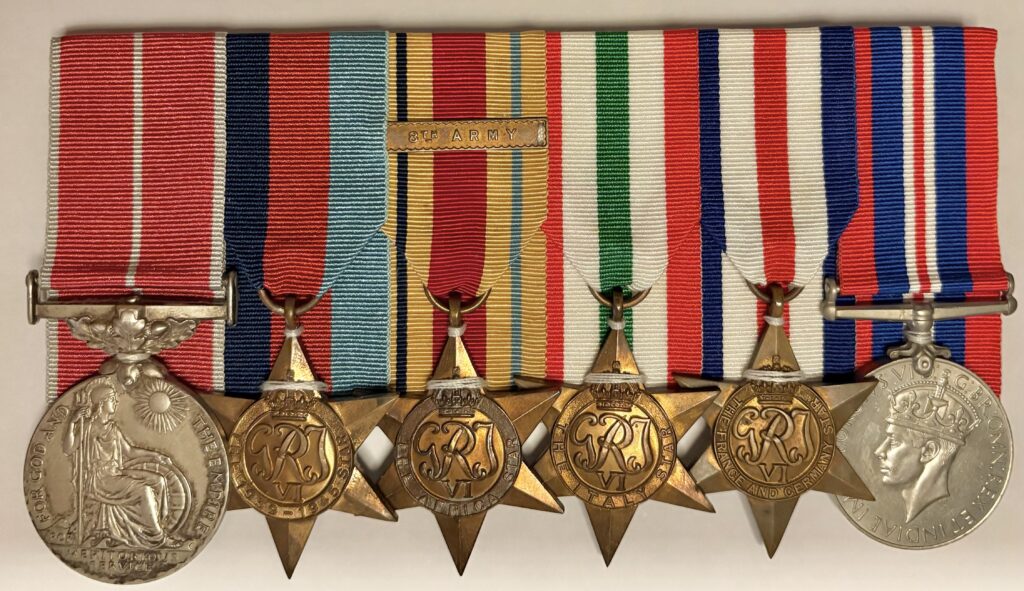
British Empire Medal (Military) GVI, 1939/45 Star, Africa Star clasp 8th Army, Italy Star, France and Germany Star, War Medal, Gunner 7th Medium Regiment Royal Artillery the recipient fought in North Africa, Sicily, and North West Europe, the Regiment landing on Gold Beach on ‘D’ Day 6th June 1944, his BEM awarded for gallantry in Holland when he rescued an officer from a Minefield who had both his feet blown off, his prompt first aid saving his life.


British Empire Medal (Military) GVI


981956 GNR Peter E Rabbitts RA


1939/45 Star, Africa Star clasp 8th Army, Italy Star, France and Germany Star, War Medal


Unnamed as issued


Mounted Court Style for display.


Peter Edward Rabbitts was born 17th March 1920, the 1939 Register records he is employed as a Machine Hand residing with his father Peter, mother Edith and brother at 5 Feltham Gardens, West Ham, Essex. Attesting for the Royal Artillery 11th July 1940 Peter joined 923 Home Defence Battery RA and the Royal Artillery Depot 20th December 1941. Drafted to Royal Artillery Field Regiment overseas 7th January 1942 and to 107 Regiment (Nottinghamshire Hussars) Royal Horse Artillery 10th September 1942 following the Regiments severe losses, it was largely destroyed and captured in June 1942 at The Cauldron during a rear-guard action. Posted to 7 Medium Regiment RA 17th February 1943, the Regiment landed in Sicily on 24th July 1943, operating under the 5th Army Group Royal Artillery. Providing heavy artillery support for Allied advances including heavy counter-battery and concentration fire during the fighting around Valguarnera alongside Canadian and British forces. On 28th August 1943, the 211th Battery engaged a German 170mm battery across the Messina Straits in Reggio. The Regiment supported fire plans for the assault across the Messina Straits on 3rd September 1943, though the main body of the regiment did not move onto the Italian mainland. Embarked for the United Kingdom in October 1943 and disembarked in Liverpool in December 1943.


Peter remained serving with 7 Medium Regiment RA until the end of the Second World War, the Regiment’s 25 and 26 batteries crossed the English Channel under German coastal shelling and landed on Gold Beach on ‘D’ Day 6th June 1944, they quickly moved inland to support the heavy fighting around Tilly-sur-Seulles and the subsequent Normandy Campaign.Following the Allied breakout in Normandy, they pursued retreating German forces toward the River Seine, supporting the push through France and eventually advancing into Belgium and the Netherlands. The egiment provided crucial heavy artillery barrages during major late-war campaigns, including the brutal Battle of the Reichswald (Rhineland Campaign) and Operation Plunder (the Allied crossing of the Rhine). The Capitulation of Germany (May 1945): The 7th Medium Regiment concluded its wartime service advancing into Germany up to VE Day, later transitioning to post-war occupation duties. Peter was demobilised on 1st July 1946, his Medal Card records the award of the 1939/45 Star, Africa Star clasp 8th Army, Italy Star, France and Germany Star and War Medal sent to his home address H.12 Stone Street, Stratford, London, E15 on 5th February 1949. He died in Newham, London 3rd June 1991.


British Empire Medal London Gazette 24th August 1945 page 4273.  ‘In recognition of gallant conduct in carrying out hazardous work in a very brave manner’. 


The original recommendation TNA WO 373/69 page 311 records –  


981956 Gunner Peter Edward RABBITTS, 27/28 Battery 7th Medium Regiment Royal Artillery.


‘On 15th March 1945, near Calgar (Holland), Gunner Rabbit’s with another soldier was accompanying an officer who was trying to recover the body of a soldier from an unmarked minefield. The officer was prodding for mines at each step, the two Gunners following him ten yards behind. In spite of all precautions the officer trod on a mine and was blown still further into the minefield. Gunner Rabbitts saw that he was gravely wounded , having lost both his feet. Notwithstanding that the mines were thickly sown, Gunner Rabbitts shouted to his companion to remain where he was and without hesitation ran to where the officer lay. He dragged him clear of the mined area and at once applied tourniquets and issued instructions for blankets etc to be brought. Gunner Rabbitts prompt and courageous action showed complete disregard for his own safety and was an inspiration to all who saw it. When a Medical Officer arrived with an ambulance he confirmed that the prompt and well judged first aid administered by Gunner Rabbitts was largely instrumental in saving the officer’s life’.


NEF £650 SOLD

Military Medal GVI, 1939/45 Star, Africa Star clasp 1st Army, Italy Star, War Medal to Sergeant James Hay, 8th Battalion Argyll and Sutherland Highlanders from Newtongrange, Midlothian, Scotland. Awarded the Military Medal for the capture of Longstop Hill, Tunisia 23rd April 1943 in which Major John Thompson McKellar Anderson, DSO of the same Battalion won the Victoria Cross. Sergeant Hay being one of the 40 other ranks to capture the position with Major Anderson. Later wounded in Italy on 20th November 1943.


Military Medal GVI


2984693 L SJT J Hay A & S H


1939/45 Star, Africa Star clasp 1st Army, Italy Star, War Medal


Unnamed as issued


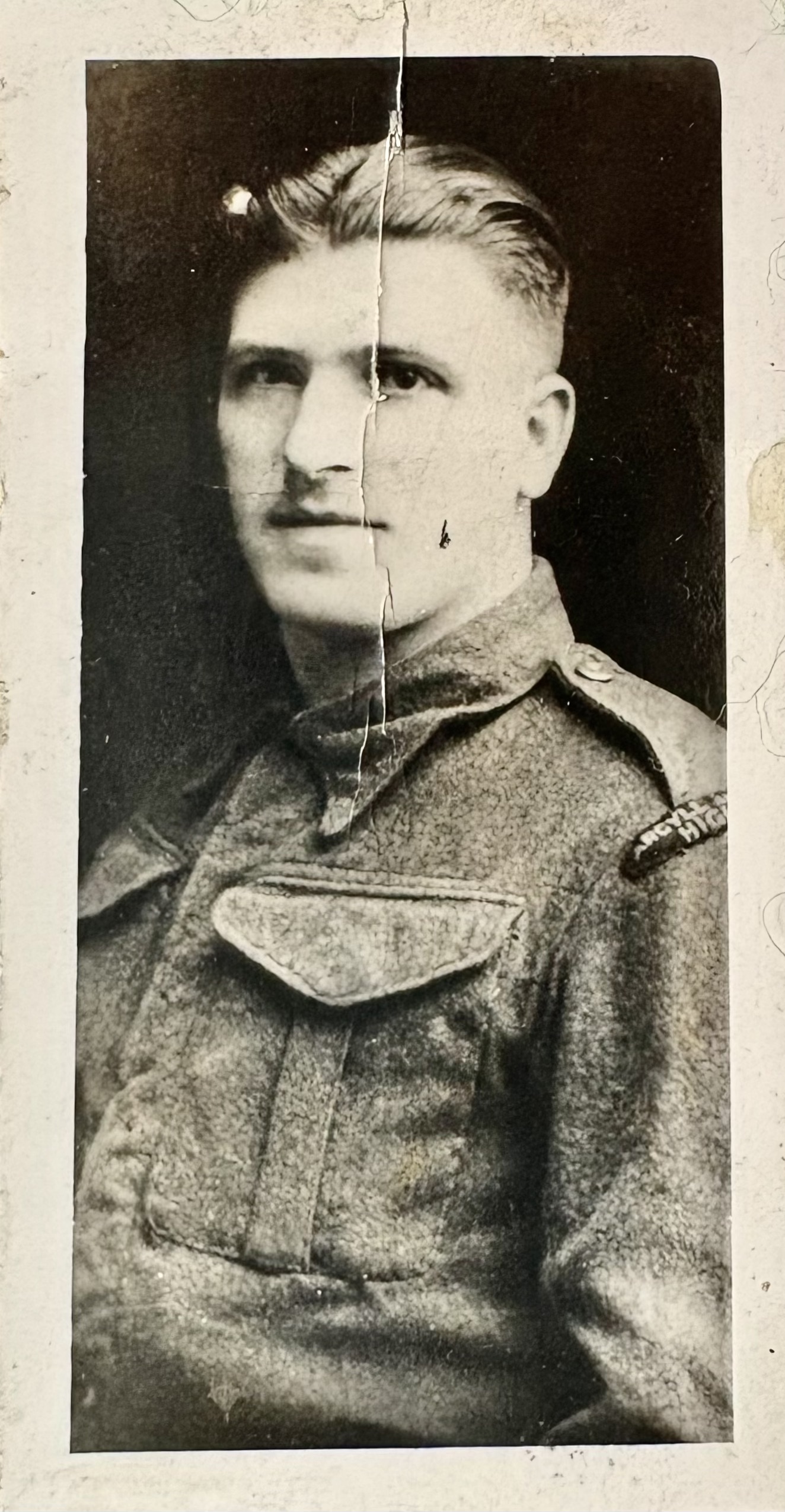
With copy research and an original (small) photo of the recipient (enlarged here).


Military Medal London Gazette 8th July 1943 page 3089 ‘In recognition of gallant and distinguished services in North Africa’.


The original citation for an immediate Military Medal TNA WO373/1 records –


2984693 Lance Sergeant James HAY, 8th Battalion Argyll and Sutherland Highlanders (36th Brigade, 78th Division) hometown – Newtongrange, Midlothian.


‘During the attack on LONGSTOP Hill on 23rd April 1943 the above NCO took charge of his platoon – his officer being wounded- and by his courage and skill led them through heavy fire with disregard of personal risk. He reached the German dug in position – forced them out of the trenches and took them prisoner. During the entire campaign he has been cheerful and efficient and by his example he has been of great assistance to men under his command’.


Lance Sergeant Hay was part of Major Anderson’s assault force that captured LONGTOP Hill numbering four officers and less than forty other ranks.


Lieutenant (Temporary Captain) (acting Major) John Thompson McKellar Anderson, DSO, 8th Battalion Argyll and Sutherland Highlanders was awarded the VICTORIA CROSS for the same action.


Victoria Cross London Gazette 29th June 1943 page 2397.


‘For conspicuous gallantry and outstanding devotion to duty during the attack on LONGSTOP Hill, Tunisia on 23rd April 1943.


Over a period of five hours Major Anderson led the attack through intense enemy machine gun and mortar fire. As leading Company Commander he led the assault on the Battalion’s first objective, in daylight, over a long expanse of open sloping hillside and most of the time without the effective cover of smoke. Enemy infantry opposition was most determined, and very heavy casualties were sustained, including all other rifle Company Commanders, before even the first objective was reached. On the first objective and still under continual enemy fire , Major Anderson re-organised the Battalion and rallied men whose Commanders, in most cases had been either killed or wounded. The Commanding Officer having been killed, he took command of the Battalion and led the assault on the second objective. During this assault he received a leg wound, but in spite of this he carried on and finally captured LONGTOP Hill with a total force of only four officers and less than forty other ranks. Fire had been so intense during this stage of the attack that the remainder of the Battalion were pinned down and unable to advance until Major Anderson had successfully occupied the hill. During the assault he personally led attacks on at least three enemy machine gun positions and in every case was the first man into the enemy pits, he also led a successful attack on an enemy mortar position of four mortars, defended by over thirty of the enemy. Major Anderson’s force on the hill captured about 200 prisoners and killed many more during the attack. It is largely due to this officer’s bravery and daring that LONGSTOP Hill was captured, and it was the inspiration of his example which encouraged leaderless men to continue the advance’.


Sergeant John Hay, 8th Battalion Argyll and Sutherland Highlanders is recorded as wounded in action, Italy 20th November 1943 in War Office Casualty List number 1313 TNA WO417/69 refers. His Second World War campaign Medals were sent to him at 24 Lothian Bridge, By Dalkeith, Midlothian on 6th January 1949.


From: The Dalkeith Advertiser 30th December 1943 page 3.

WAR CASUALTY

Mrs James Hay , Fifth Street, Newtongrange, has been officially informed that her husband Sergeant James Hay, Argyll and Sutherland Highlanders has been wounded while fighting with the Central Mediterranean Forces. Sergeant Hay was previously wounded in the North African campaign, where, for conspicuous gallantry , he was awarded the Military Medal. His parents also reside in the village.


GVF & better £1,950 Available

British Empire Medal E2 (Civil Division), Skilled Fitter, British Aerospace RAF Bitteswell.


British Empire Medal E2 (Civil Division)


Henry Leslie Heath


With investiture pin in Royal Mint presentation case, a Birthday Honours 1979 award.


From: The Coventry Evening Telegraph 16th June 1979 page 18.


Mr Henry Heath who has been a shop steward at British Aerospace, Bitteswell for about 30 years received the British Empire Medal (BEM). He has worked at Bitteswell for 34 years, and was a shop steward for the Amalgamated Union of Engineering Workers until February. Mr Heath a skilled fitter at the Kingstonbrough division of the Bitteswell unit lives at 20 Covent Close, Kenilworth. He is 65 years old and married with one daughter.


The award also announced in The Birmingham Evening Mail 16th June 1979 page 7 ‘Henry Leslie Heath of Kenilworth, skilled fitter, British Aerospace’.


RAF Bitteswell was a former military airfield and aircraft manufacturing/maintenance facility located near Lutterworth in Leicestershire, England.  It opened in June 1941 as an RAF station and bomber training/operations base, later used for Lancaster assembly and general maintenance. Post war it was taken over by the Ministry of Supply in 1947. Sir W. G. Armstrong Whitworth Aircraft (later Whitworth Gloster, Hawker Siddeley, and British Aerospace) used the site for final assembly, flight testing, jet/turboprop engine development, and overhauls. It handled aircraft such as the Avro Lancaster, Gloster Meteor, Hawker Hunter, Avro Shackleton, Avro Vulcan, and AW.650 Argosy. It also served as a maintenance and delivery base for the Red Arrows (servicing Folland Gnats and later preparing BAe Hawk T.1 trainers). Company flying ended on 30 June 1982 following the retirement of the Vulcan and shifting industry footprints.  The site was cleared and redeveloped into Magna Park, a major logistics and distribution centre, starting after 1986. 

As awarded


EF £175 Available includes postage UK address

Military Medal GVI, 1939/45 Star, Africa Star, Italy Star, France and Germany Star, War Medal to Private William Carter, 5/7th Battalion Gordon Highlanders a former plumber from Motherwell, North Lanarkshire. Landing on Juno Beach on ‘D’ Day, he was awarded the MM for his gallantry on 11th June 1944 during Operation Stack agains heavily defended German positions. Killed in action near St Sylvan, France on 14th August 1944 age 28 years.


Military Medal GVI still with investiture pin / brooch


14211960 Pte W Carter Gordons


1939/45 Star, Africa Star, Italy Star, France and Germany Star, War Medal


Unnamed as issued


His Second World War Stars and Medal confirmed on his Medal Card, all sent to his widow at 124 Station Road, Blantyre, Glasgow on 24th April 1950.


The 5th/7th Gordons were the first troops of the 51st (Highland) Division to land on 6th June 1944 on Juno Beach, closely followed by 1st Gordons. 2nd Gordons landed two weeks later. All were immediately thrust into heavy action in the Normandy countryside against a battle-hardened enemy determined to push the invading Allies back into the sea. Two months of bitter fighting followed, but by mid-August 1944 the breakout from Normandy was underway.


Military Medal London Gazette 31st August 1944 page 4049 ‘In recognition of gallant and distinguished services in NORMANDY’.


The original citation records (TNA WO373/48 page 551)


14211960 Private William Carter, 5/7th Battalion Gordon Highlanders


153 Infantry Brigade, 51st (Highland) Division


I have the honour to recommend No.14212960 Private CARTER, W of the 5/7th Battalion Gordon Highlanders for an immediate award.


On 11th June 1944 the Battalion advanced to capture the village of TOUFFREVILLE. ‘C’ Company was left forward Company of which 14 Platoon was right forward Platoon. The Platoon came under intense fire from three German Machine Guns and several rifles. Fire was returned but the enemy became more accurate and intense. Private CARTER then on his own initiative, stood up and ran 150 yards in open ground to the nearest Platoon of ‘B’ Company on the right, took a deserted Bren Gun and ammunition, and fired into the enemy until two complete Sections were able to manoeuvre on open ground. Private CARTER’s position was, during this time, under intense enemy mortar fire. Private CARTER showed skill, coolness, initiative and daring throughout the whole battle. He was armed with a .38 pistol.


On 9th July 1944, after the cessation of Operation Charnwood north of Caen, the Germans reinforced their positions and in particular Colombelles. General Montgomery, commander of the 21st Army Group, then ordered the destruction of the chimneys of the Société Métallurgique de Normandie (Metallurgical Society of Normandy) factory, used by German artillery observers: this operation took the name Operation Stack. It opposed the following German units: the Luftwaffen-Jäger Regiment 32 of the 16. Feld-Division (L), the Schwere Panzer-Abteilung 503 and the II/Panzergrenadier-Regiment 125 of the 21. Panzer-Division. Conduct of Operation Stack – On the night of 10th -m 11th July, the 153rd Infantry Brigade, consisting of the 5th Battalion The Black Watch, 1st Battalion The Gordon Highlanders and 5/7th Battalion The Gordon Highlanders, launched an attack on positions defended by the Schwere Panzer-Abteilung 503. Infantry is supported by the Sherman and Firefly tanks of the 148th Royal Armoured Corps (RAC). The British soldiers were quickly pinned down by violent bombardments of mortars and Nebelwerfer of the Werfer Regiment. The tanks of the 3rd company under the command of Oberleutnant Richard Freiherr von Rose (the unit commander, Hauptmann Scherf, temporarily replaces the unit commander, sick) counterattack at dawn and destroy 9 of 10 Sherman of A Squadron of the 148th RAC. Three other armoured vehicles were put out of action and the Germans captured two Shermans: one of them was later used as a tow truck for the benefit of the regiment. The 153rd Infantry Brigade retreated, abandoning the hope of achieving the goals of Operation Stack.

William Carter was killed in action on 14th August 1944 age 28 years, the Battalion War Diary records –


14th August 1944 – The Battalion moved during first light to St SYLVAN with a view to attacking the wood to the south east. In St SYLVAN the Battalion came under shell and mortar fire and suffered casualties. The attack on the wood was very successful and a large number of prisoners were taken. Our casualties were comparatively light in comparison but the difficulty in evacuating the wounded was considerable owing to Machine Gun and mortar fire. The stretcher bearers did magnificent working worked ceaselessly all day. Private Hutchinson did particular good work. Some very fine officers and men were lost, but the morale of the Battalion was terrific and it was just such an action as this that was needed to give the Battalion the “punch” it required. Casualties were six officers wounded, eight other ranks killed and thirty nine wounded.


William Carter now rests in an identified grave in the Ranville War Cemetery, France, the son of James and Elizabeth Carter, husband of Charlotte G McKay Carter of Blantyre, Lanarkshire. He is commemorated on the Motherwell War Memorial, his headstone bear these words from his wife –


“I SIT ALONE BY THE FIRESIDE DREAMING OF YOU, DEAR BILL & THE DAYS BEYOND RECALL”.


From: The Motherwell Times 23rd August 1944 page 1


LOCAL “GORDON” WINS MM – GALLANTRY in FRANCE


Serving in France with the British Army of Liberation Private William Carter, Gordon Highlanders, of Oakfield Place, Motherwell has been awarded the Military Medal. Writing to his parents Private Carter makes modest reference to the award saying he is “no medal hunter”, and they were not to get the wrong idea about him. Like many more of the lads of the Liberation Army he hoped it would not be long till their job was done and they would all be together again for good and all. Private Carter joined the Army in 1942, prior to which he had been for seven years in the employment of James F McCleary, Plumber, Heating and Sanitary Engineers 16 Airless Street, Motherwell. “I only wish the war were won, and I was back again with the old firm’ Carter writes to a former colleague with whom he worked while with Mr McCleary. He also in his letter makes reference to the Military Medal bestowed upon him.


TWO PLUMBER MM’s


By coincidence Private Carter is the second Military Medalist among Mr McCleary’s apprentices. The first apprentice to gain the award was the late Private John Watson, MM of 41 Thorndean Place, Thorn Street, Motherwell. Private Carter learned in France of his death in action of his former workmate and makes the following reference to the sad event in one of his letters home. “I dare say you will all take it bad about John Watson’s death in action”, he writes “I know it was a big shock to me when I was at his Battalion Headquarters to find out about him and was told he was amongst the fallen. If ever I get the chance I will take a turn along and see his grave”. Private Carter is married and his wife and one child are presently staying in Blantyre. His parents Mr and Mrs James Carter are old residents of Oakfield Place.


From: The Motherwell Times 23rd August 1944 page 5


MM KILLED AFTER AWARD


An announcement is made in the front page news in today’s issue of the award of the Military Medal to Private William Carter, Gordon Highlanders. Yesterday news was received of Private Carter’s death on service, he was killed some days following the award conferred on him. Carter was a workmate of Private John Watson MM who’s death in action was reported a few weeks ago.


A total of 137 Military Medals and 5 Bars awarded to the Gordon Highlanders, all Battalions for the entire Second World War.


GVF £2,050 SOLD

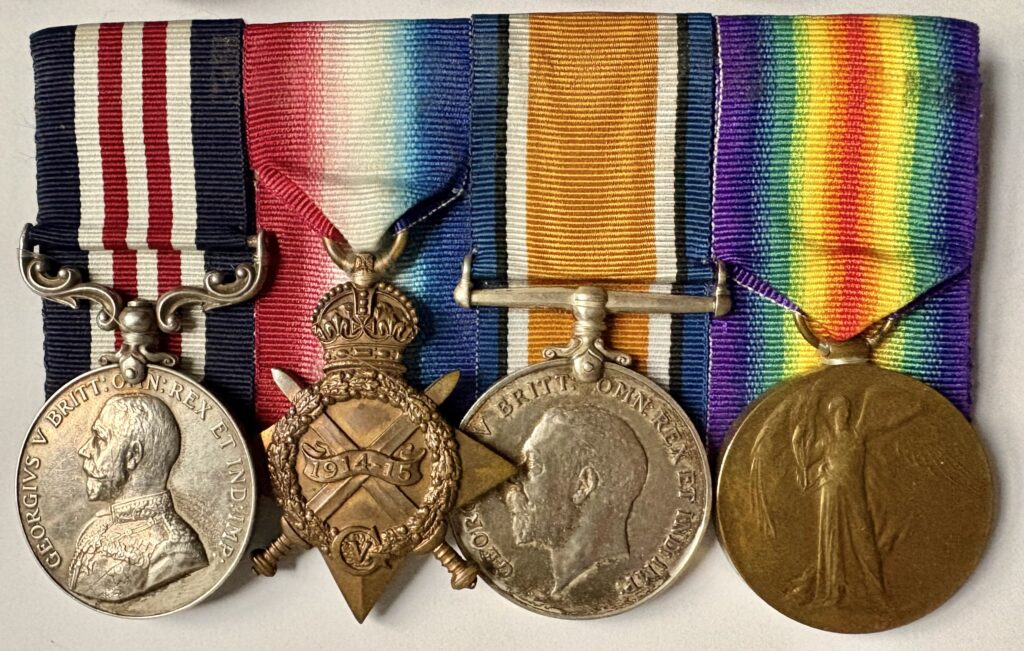
Military Medal GV, 1914/15 Star, British War and Victory Medals to Corporal, 6th Battalion Shropshire Light Infantry, the recipient awarded the Military Medal for the Battle of St Quentin during the German Spring Offensive 22nd to 25th March 1918. The recipient born in Swansea in 1894, he resided and worked there for most of his life and died in Swansea in 1965.


Military Medal GV


11726 Cpl H Parker 6/Shrops LI


1914/15 Star


11726 Pte H Parker Shrops LI


British War and Victory Medals


11726 Cpl H Parker Shrops LI


Court mounted for display.


With copy research and details here extracted from online records.


Born Edward Henry Parker in Swansea 14th July 1894, the 1911 census records Edward is a 16 year old Engine Cleaner employed by the London and North West Railway Company residing with his father Henry a Dock Labourer, mother Mary Jane, three brothers and three sisters at 38 Janes Street, Swansea. Edward attested for the King’s Shropshire Light Infantry shortly after the outbreak of war serving as ‘Harry Parker’. Joining the 6th Battalion, he served in France from 24th July 1915, his British War and Victory Medal roll entry records service with the 6th Battalion only TNA WO329/1472 page 965 refers. The 6th Battalion were formed in Shrewsbury in September 1914 as part of Kitchener’s New Armies, drawing volunteers from towns across Shropshire. Attached to the 60th Brigade in the 20th (Light) Division they landed  in France in July 1915 and fought entirely on the Western Front, participating in major actions including the Battle of Loos (1915), the Somme (1916, including Serre), and Ypres (1917). Awarded the Military Medal London Gazette1918 page 2839. Recorded as wounded in action in War Office Daily Casualty List number 5591 dated 13th June 1918, his wounding also recorded in the Ludlow Advertiser 29th June 1918. ‘Harry’ recovered from his wound and was discharged to Class ‘Z’ Army Reserve 17th February 1919. Edward married Mary Jane Rees (1895-1980) in Swansea in 1916 (presumably whilst on leave), the 1921 census records ‘Harry Parker’ (back to his preferred name) is a 26 year 11 month old Dry Dock Labourer residing with his mother, two brothers and one sister (wife absent) at 38 James Street, Swansea. The 1939 Register records Edward Henry Parker (back to his real name for his identification document) is employed as a Gas Washer at the Power Station residing with his wife Mary Jane and daughter at 213 Bonymaem Road, Swansea, he died in Swansea in 1965.


Military Medal was awarded for gallantry during the battle of St Quentin (German Spring Offensive), the Regimental History records the action –


At 1330 hours on 22nd March 1918 the enemy attacked and drove in the Regiments holding the line in front of the 6th Battalion. The 6th King’s Shropshire Light Infantry (KSLI) under Lt Colonel H E Welsh, on the right, made a final stand west of Happencourt, with the enemy on both flanks. As the Germans came down shouting and singing, they were surprised by Lewis Gun fire from the Battalion, and were completely routed. At 2300 hours the Germans who had crept up close, under cover of a dense mist, drove a wedge between two companies of the 12th King’s Royal Rifle Corps and got into the trenches of 6th KSLI, cutting off practically the whole of ‘B’ company and taking many prisoners. Colonel Welch led a counter attack with his own Battalion HQ, but was driven back by overwhelming numbers. The companies retiring in different directions became separated from the Brigade until the afternoon of the 24th. On the 28th the Battalion was relieved by the French, and concentrated with the Brigade east of Hangest. The Brigade was soon reformed and on the 29th marched to Rifle Wood. The same day the 6th KSLI went to the support of 59th Brigade which was heavily attacked around Mexieres. About 1430 hours Lt Colonel Welch was mortally wounded by shrapnel and died a quarter of an hour afterwards near Villers.


On the 31st the Division was again heavily attacked, and the 6th KSLI, coming up from a position south east of Domart to protect the right flank, succeeded in stopping the enemy advance for a time and causing his serious loss. The cavalry came up on this occasion and secured the right flank, the 6th KSLI and 11th DLI being placed under the command of the General Officer Commanding Cavalry until the Division was relieved on 2nd April. The incessant fighting in March, and the extremely heavy losses suffered, left the Division unfit to take the field. Large reinforcements came to 6th KSLI and no time was lost in reorganising the Battalion. On the 1st and 3rd May the Battalion was with its Brigade in the Avion and Lens sector. On the 25th the undermentioned NCO’s and men were awarded the Military Medal for bravery during the periods 22nd March to 1st April 1918………..Corporal H Parker (a total of 20 Military Medals awarded and one second award bar to the Military Medal).


GVF & better £575 Available includes postage UK address