Single Campaign Medals

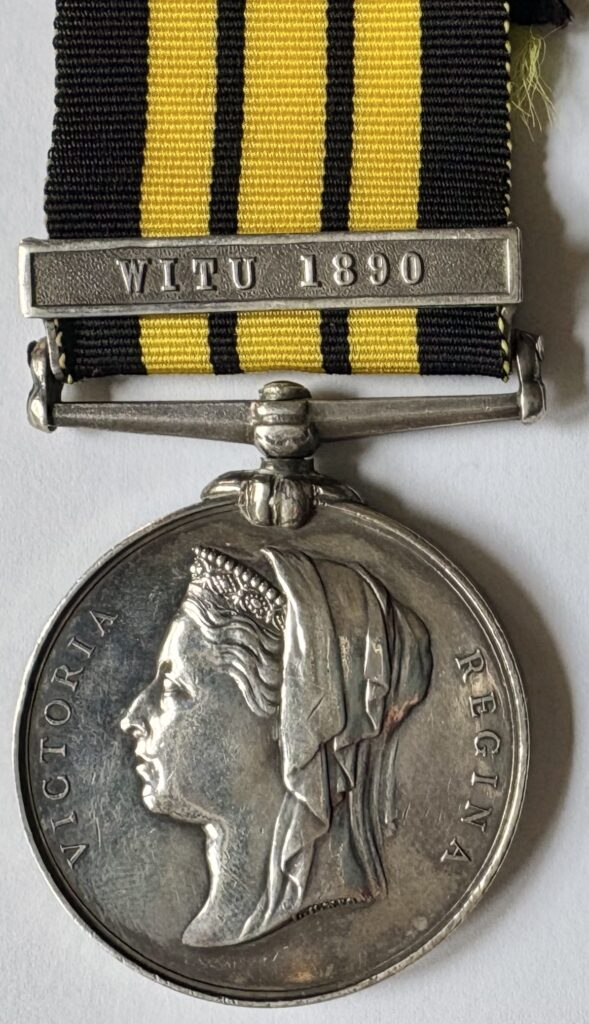
East and West Africa Medal clasp WITU 1890, Able Seaman HMS Brisk, later Chief Petty Officer HM Coastguard.


East and West Africa Medal clasp WITU 1890


A Strange AB HMS Brisk


With details here extracted from his online service record.


Arthur Strange was born in Circkdale, Wiltshire 24th January 1865 a Page Boy he entered the Royal Navy as Boy 2nd Class aboard HMS Impregnable 17th December 1880. Rated Ordinary Seaman aboard HMS Northampton 10th October 1882 and Able Seaman aboard HMS Fantome 20th December 1885, he served aboard HMS Brisk from 20th March 1888 to 7th February 1891 including the Witu Expedition of 1890. Arthur transferred to HM Coast Guard 11th May 1892 joining the Portrush Station as Boatman. Advanced to Commissioned Boatman 24th May 1900, he was posted to the Port Ballintoy Station 22nd June 1900, to Bangor 15th January 1903 and advanced to Chief Boatman 27th June 1907. Posted to St Martins 17th September 1907, to Minehead 12th November 1909 and rated Petty Officer (Coast Guard) 1st April 1910. Posted to Pentewan 5th January 1911, he was advanced to Chief Petty Officer (Coast Guard) 12th April 1911 and invalided no longer fit for service 8th August 1912. Awarded the Long Service and Good Conduct Medal 1st March 1907. The 1921 census records Arthur is a Naval Pensioner, not employed residing with his wife Ellen, one son and three daughters at 84 Kingskerswell Road, Newton Abbot. The 1939 Register records Arthur is still residing at the Kingerswell Road address recording is occupation as Naval Pensioner and Coastguard Station Officer (Retired) residing with his wife, he died in Newton Abbot in 1942.


A total of 90 East and West Africa Medals to the Archer Class Torpedo Cruiser HMS Brisk.


NEF £350 Available

Queen’s South Africa Medal clasps Cape Colony, Orange Free State, Transvaal, South Africa 1901, South Africa 1902, Major, Rifle Brigade later Brevet Colonel his only Medal entitlement.


Queen’s South Africa Medal clasps Cape Colony, Orange Free State, Transvaal, South Africa 1901, South Africa 1902


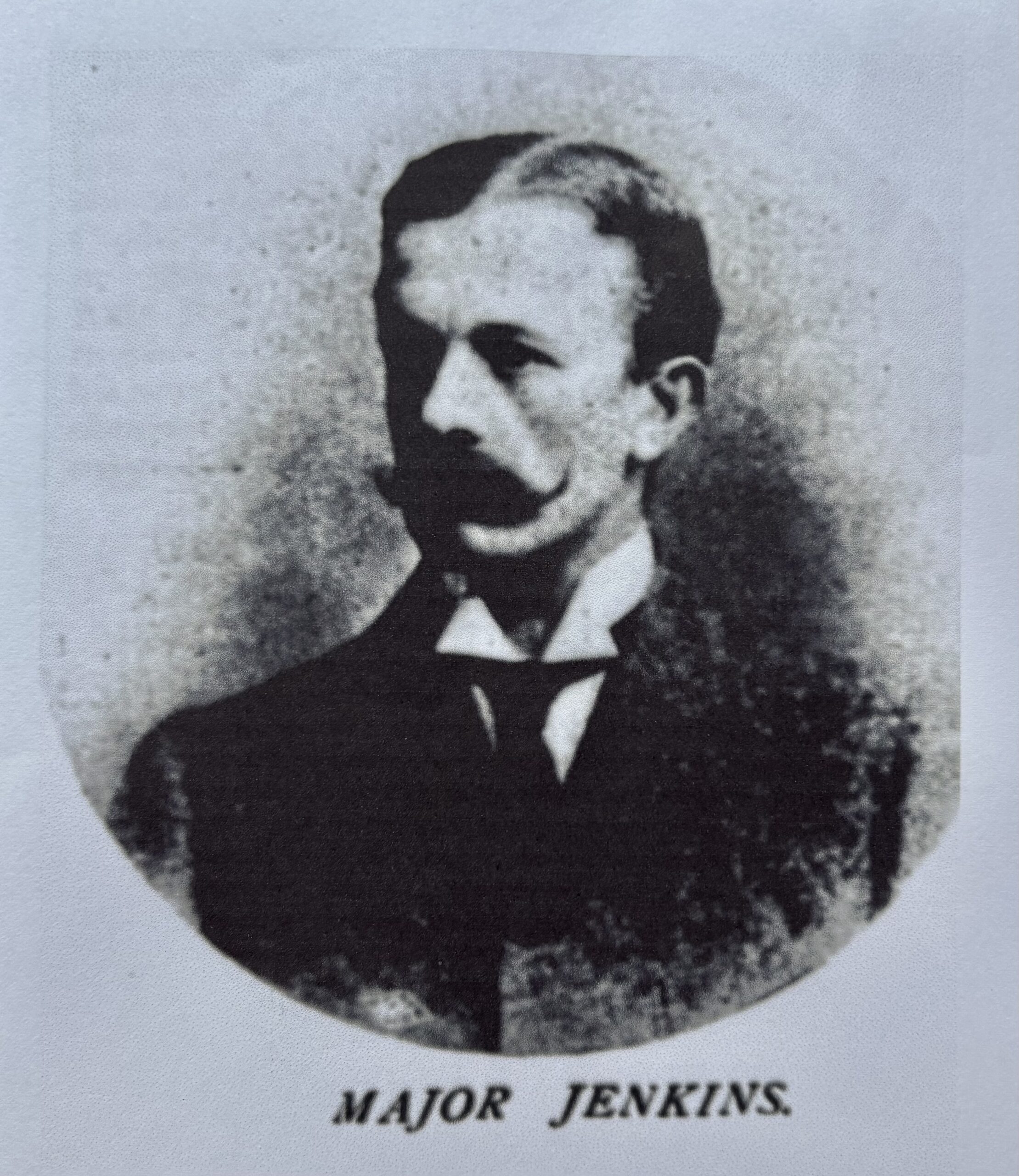
Major A E Jenkins Rifle Bgde


Mounted as originally worn.


With details here extracted from his online service records, Army Lists, newspapers, London Gazette and other online records.


From: The Ladies Field Magazine 22nd April 1899 page 307 article announcing his marriage.


Atherton Edward Jenkins was born in Brighton 31st August 1859, the son of Edward Jenkins, Indian Civil Service and Jane The Dowager Countess of Lovelace. Educated privately, Atherton was commissioned Sub Lieutenant 2nd Royal Surrey Militia 14th October 1876 (London Gazette 3rd October 1876 page 5295) and promoted Lieutenant 14th October 1876 same seniority backdated (London Gazette 10th October 1878 page 5082). Having served 2 years 103 days in the Militia Atherton was commissioned 2nd Lieutenant 93rd Highlanders Regular Army 15th January 1879, transferring as 2nd Lieutenant to the 2nd Battalion Rifle Brigade 30th April 1879, promoted Lieutenant 12th March 1881, Captain 1st March 1888, Major 1st September 1896, Brevet Lieutenant Colonel 22nd August 1902, Lieutenant Colonel 18th December 1903 and Brevet Colonel 19th April 1906, retiring on Retired Pay 14th May 1913. Atherton served abroad in Gibraltar from 10th March 1879 to 20th December 1880, Halifax Nova Scotia, Canada 16th May 1888 to 3rd March 1892, India 4th March 1892 to 26th January 1894, South Africa 1st June 1901 to 11th September 1902 and Malta 12th April 1904 to 24th October 1906. ADC to General Officer Commanding (Lieutenant General Sir John Rose) in Canada 24th May 1888 to 31st December 1891, ADC to General Officer Commanding Eastern District UK 1st October 1894 to 31st December 1895. Second in Command of the 1st Battalion Rifle Brigade in South Africa from 29th May 1901 and commanded a section of the 1st Battalion Rifle Brigade Mounted Infantry in South Africa in 1902. Mentioned in Despatches (General Kitchener) London Gazette 29th July 1902 page 4848. Brevet Lieutenant Colonel to date 22nd August 1902 “In recognition of his services in South Africa” London Gazette 31st October 1902 page 6905.


Atherton before he retired from the Army was the Commandant of the Rifle Brigade Depot at Winchester and Colonel in Charge of Rifle Bridade Records. He married Miss Anna Isabella Cassel at St George’s Church, Hanover, London 22nd April 1899 the couple were to have one daughter Marjory Minna Jenkins, later Countess of Brecknock. When the Great War broke out Atherton was appointed Commandant of a training camp until he was relieved on 12th January 1916 (London Gazette 25th January 1916 page 1083), he saw no overseas service during the Great War. The 1921 records Atherton is a 61 year 10 month old Landowner and Farmer residing with his wife , Ladies Maid, Cook, Kitchen and House Maids at Wherwell Priory, Andover, Hampshire where he was also a Justice of the Peace (JP), he died at the War Memorial Hospital, Andover on 28th January 1945.


This is his only Medal entitlement. One slight edge knock at 5 o’clock otherwise


GVF & better £495 Available includes postage UK address

Queen’s South Africa Medal clasp Defence of Ladysmith, Private 1st Battalion Liverpool Regiment invalided home following the relief.


Queen’s South Africa Medal clasp Defence of Ladysmith


5669 Pte J Brown L’pool Regt


Medal with single clasp Defence of Ladysmith confirmed on the Medal roll of the 1st Battalion Liverpool Regiment TNA WO100/172 page 52 refers. The remarks column records the recipient invalided to England 18th August 1900. The siege of Ladysmith lasted from 2 November 1899 and 28 February 1900, many soldiers suffered from diseases as a result and were unfit to continue to serve in South Africa and were returned home.


GVF & better £195 SOLD

India General Service Medal GV clasp Afghanistan NWF 1919, Private 1st (Garrison) Battalion Gordon Highlanders, one of 215 Medals and clasp to the Regiment.


India General Service Medal GV clasp Afghanistan NWF 1919


S-16758 Pte A Digweed Gordons


Albert Digweed first served in the Royal Scots Fusiliers (No 11263), the award of the British War Medal and the India General Service Medal clasp Afghanistan NWF 1919 is conformed on his Medal Index Card, his First World War Medal roll entry records service with the 1st (Garrison) Battalion Gordon Highlanders TNA WO329/1664 page A.53 and the India General Service Medal roll TNA WO100/113/479 page 9 which records ‘Discharged to Class ‘Z’ Army Reserve 22nd January 1922′.


A total of 212 India General Service Medals clasp Afghanistan NWF 1919 awarded to the 1st (Garrison) Battalion Gordon Highlanders a further 3 clasps were awarded to soldiers of the 2nd, 3rd and 9th Battalions making a total of 215 to the Regiment ref: Taming the Tiger, The Sory of the India General Service Medal 1908-35 by Richard G M L Stiles, Savanah Publications, 2012.

Scarce


First time on the market.


NEF £250 includes postage UK address

South Atlantic Medal with Rosette, Air Electrical Mechanic (Radar) 826 Squadron Fleet Air Arm.


South Atlantic Medal with Rosette


AEM(R) P A Finney D155714A 826 SQN


Medal mounted as originally worn, service number indicates 1975 enlistment, Paul Finney was discharged from the Royal Navy in 1985. With a group photo of the Engineers of 826 Squadron containing Finney.


AEM(R) = Air Electrical Mechanic (Radar).


Fact Slap 👋 Today in 1982, A 826 Squadron ASW Sea King from HMS HERMES is forced to ditch in the sea with engine failure. The crew of 3 escape with minor

.
A Sea King Helicopter of 826 Squadron (HMS Hermes) is forced to ditch in the sea off the Falkland Islands, the crew of three successfully escaping.


826 Squadron Fleet Air Arm was reformed a sixth time on 2 June 1970 with Westland Sea Kings, serving aboard HMS Eagle until the carrier decommissioned in January 1972. The squadron then operated from the helicopter training ship RFA Engadine and from December 1972, from the cruiser HMS Tiger. It continued to operate its Sea Kings from HMS Tiger until 1978, when it transferred to the carrier HMS Bulwark, receiving Sea King HAS.5s in March 1981, and embarking aboard HMS Hermes in September that year (Bulwark having been paid off in March 1981). Following the Argentinian invasion of the Falkland Islands in April 1982, the squadron, equipped with nine Sea King HAS.5s, deployed aboard HMS Hermes as part of the Operation Corporate Task Force sent to retake the Islands. The squadron carried anti-submarine and surface search patrols around the task force, unsuccessfully attacking a suspected Argentine submarine on the night of 1/2 May, and also rescued survivors from HMS Sheffield, HMS Coventry and Atlantic Conveyor. Four Sea Kings were transferred to the stores ship RFA Fort Austin to free up space aboard HMS Hermes on 17 May. The Squadron lost two helicopters during the Falklands War, but on both occasions the crews escaped unharmed. After the end of the war, the Squadron was split into a number of independent flights operating from Royal Fleet Auxiliary ships, and deployed in turn to the South Atlantic, these operations continuing until 1986. After that period, the Squadron was split into 4 flights of two Sea Kings each, operating from Type 22 frigates, Royal Fleet Auxiliaries and aircraft carriers as required


NEF £850 Available